
 Download Brochure
 +91 97271 71531
 info@divinecooling.com
 Posted by
 It is highly convenient to purchase products and goods as fresh as when they were at the point of origin, whether from anywhere across the globe, at your local retail stores, or via online shopping. This is because it depends heavily on specialized shipping containers. Among the most common types, reefer containers and standard containers are created to keep products cool or warm, as required, and are the cornerstone of temperature-controlled transport as well as storage.
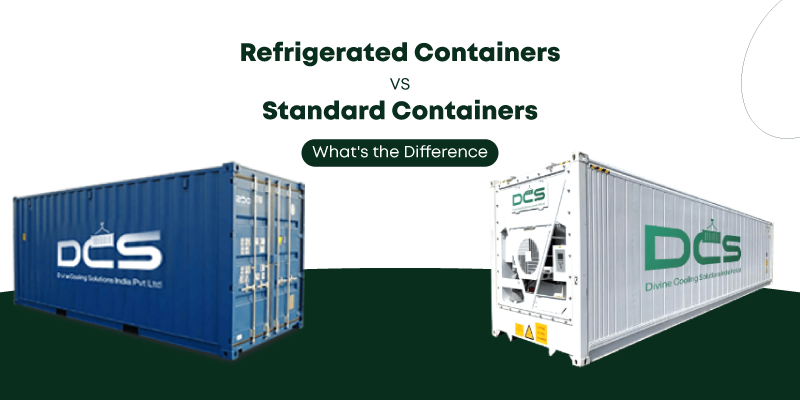
Reefer refrigerated containers and standard containers, though sharing the same purpose, differ in many ways. So, if you are planning to get a container storage on rent, it is essential to first understand both types and their differences to help you make an informed decision.
Definition
A reefer container is a shipping container with temperature control, equipped with a built-in cooling unit, designed to transport or store perishable goods by maintaining precise temperatures, airflow, and humidity during storage period & during transit by road, rail, or sea.
A standard reefer container is the most commonly used basic model in the category. The standard reefer container provides basic cooling but lacks the specialized environmental controls found in CA refrigerated reefer containers.
Temperature Control Capabilities
Both types of containers regulate temperatures, but their precision levels differ. Advanced superfreezer refrigerated containers can reach much lower temperatures, supporting ultra-low freezing and highly accurate temperature control.
In contrast, standard reefer containers are designed to maintain a set temperature, which is crucial for preventing spoilage, making them suitable for agricultural and food products but less ideal for ultra-sensitive products.
Technology and Features
Reefer CA control containers are equipped with advanced features, including modified atmosphere, controlled atmosphere, humidity control, and a remote monitoring system. These state-of-the-art technologies minimize spoilage, extend shelf life, and slow ripening.
Standard refrigerated containers provide only basic protection of temperature regulation, as they are built with technologies that focus solely on basic refrigeration and airflow and don’t manage humidity, oxygen, or carbon dioxide levels.
Types
Standard reefer containers generally come in a limited range of configurations and types, and, aside from minor features and size, a standard reefer looks the same across most uses.
While custom reefer refrigerated containers come in:
- High-Capacity and Dual-Temperature Units
- Open-Top and Insulated Variants
- Controlled Atmosphere and Hanging Options
Customization Options
Reefer refrigerated containers offer extensive customization options. So if you get cold storage container rentals, you can choose a reefer refrigerated container to transport or store goods that require highly controlled conditions or specialized handling. This is because the reefer container features dual temperature zones. It keeps one section frozen while the other remains chilled. Some reefer containers also offer specialized racking systems that enable them to handle goods like garments or meat, as they can customize both the container layout and the internal environment.
In comparison, the standard reefer container is designed to keep goods chilled and maintain temperature, and relies on basic monitoring and manual checks. It doesn’t allow for customization when storing specialized products with specific environmental condition requirements.
Conclusion
Choosing between reefer refrigerated containers and standard reefer containers depends entirely on what you’re storing. If it’s just products like fresh fruits and vegetables, dairy products, beverages, etc., a standard container usually does the trick and is often budget-friendly. If it’s highly sensitive goods like vaccines, insulin, premium meat cuts, temperature-sensitive chemicals, or heat-sensitive cosmetics, then CA control reefer refrigerated containers are a suitable option. Consider your needs and the refrigerated shipping container price in India, and you’ll figure out the best way to get it where it needs to go safely.