
 Download Brochure
 +91 97271 71531
 info@divinecooling.com
 Posted by
 Large-scale businesses or import/export businesses transport goods from one place to another on a frequent basis. They prefer using shipping containers for this as they are available in multiple sizes and types. You can choose a cold storage container, a normal storage container, or an insulated container, depending on your requirements. All of them have their own benefits and use cases.
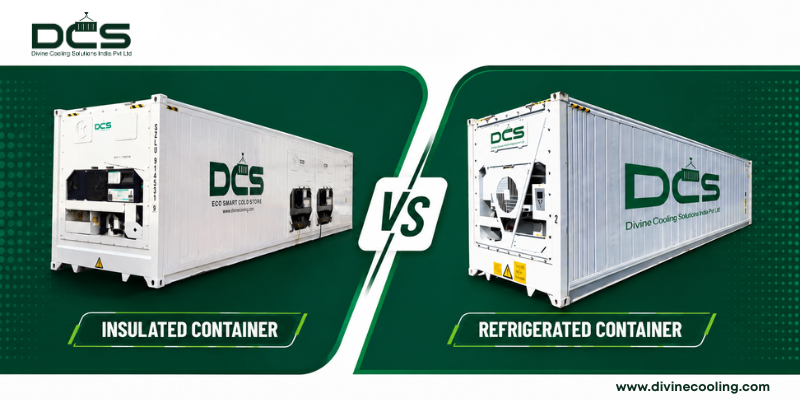
In the following blog, we are going to explain the differences between refrigerated containers and insulated containers for site storage purposes.
What are Refrigerated Containers?
They are also known as reefer containers. These special containers have refrigeration systems installed that can withstand extremely low temperatures (ranging from +25 degrees Celsius to -25 degrees Celsius). They are mostly used for storing perishable items such as food, vaccines, pharmaceuticals, vegetables, and seafood. You can buy a 40-foot or a 20-foot refrigerated container as per your requirements from a temperature range of minus 70 deg C to plus 100 deg C.
What are Insulated Containers?
Insulated containers are a type of container that are specifically designed to withstand harsh ambient temperatures & keep a few degrees better than the surrounding environment. They are also used in the transportation of temperature-sensitive materials, but they do not need refrigeration to maintain product quality.
Difference Between Refrigerated and Insulated Containers
Temperature Control: Only Refrigerated Containers have a temperature control system; they maintain certain temperatures which are ideal for the store’s product. Refrigerated containers require electricity or a genset as a power source, while insulated containers are basically large storage boxes where a few degrees of temperature are regulated, but do not have a refrigeration system.
Energy Consumption: Refrigerated containers use more energy as they use active cooling methods through motors and generators. On the other hand, insulated containers regulate temperature through their insulated walls and do not require any power supply.
Maintenance: Refrigerated containers should be maintained properly by keeping their power source intact and keeping a stable temperature through generators. The specific temperatures in an insulated container cannot be managed. Both are equally durable, so neither of them requires a civil construction or shed to keep them in an open space.
Operational Cost: The refrigerated shipping container price in India might be higher than that of insulated containers, but they are more efficient and capable of preserving the freshness of perishable items for a longer time.
Conclusion
Refrigerated containers are mainly used to store and transport items such as seafood, beverages, and other food items that need to be kept at a specific temperature to extend the shelf life of the product.
Meanwhile, insulated containers can be used to store vegetables like onions, potatoes, cabbage, carrots, and tomatoes for a shorter period of time. They keep the items better than the surrounding temperature throughout the storage tenure and keep them from rotting.
Now that you know the difference between refrigerated and insulated containers, you can easily make an informed decision when you are searching on the internet for “cold storage near me” or “insulated container near me” for your business.